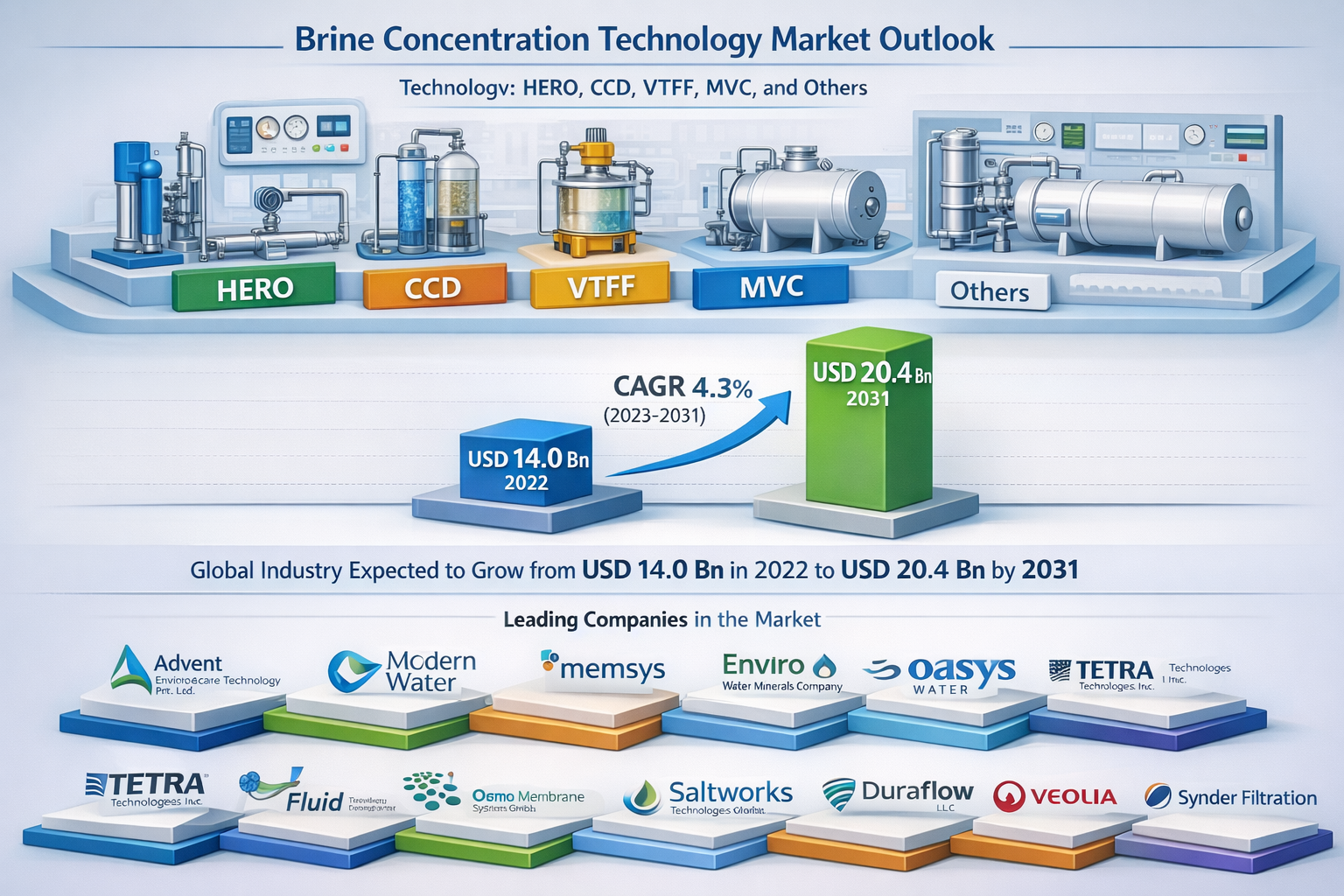
The global brine concentration technology market was valued at USD 14.0 billion in 2022 and is projected to reach USD 20.4 billion by the end of 2031. Growth is driven by increasing demand for water and wastewater treatment, zero liquid discharge (ZLD) regulations, and rising industrial water reuse initiatives, with the industry expected to advance at a CAGR of 4.3% from 2023 to 2031.
The global Brine Concentration Technology (BCT) Market is entering a transformative phase as industries pivot toward sustainable water management and resource recovery. Brine concentration involves advanced processes designed to treat high-salinity wastewater (brine), typically containing sodium chloride and other salts like calcium sulfate and silica. This technology is a critical pillar for achieving Zero Liquid Discharge (ZLD) and meeting the growing demand for industrial freshwater.
Transform Your Strategy: Explore In-Depth Data – Sample Available! https://www.transparencymarketresearch.com/sample/sample.php?flag=S&rep_id=44285
The BCT market is fundamentally driven by the escalating global water crisis and stringent environmental regulations regarding the discharge of saline effluents. As traditional freshwater sources deplete, industries are increasingly looking at "waste" streams as a resource. Brine concentration technologies not only minimize the environmental footprint of industrial operations but also facilitate the recovery of valuable minerals like lithium, magnesium, and calcium.
Market Segmentation
By Service Type
- Installation & Commissioning: High-growth segment due to new ZLD mandates.
- Operations & Maintenance (O&M): Steady revenue stream driven by the scaling and fouling management of existing plants.
- Consulting & Engineering: Growth in feasibility studies for mineral recovery from brine.
By Sourcing Type
- Seawater: Primarily for large-scale desalination projects.
- Industrial Wastewater: Focus on power plants, textiles, and steel mills.
- Produced Water: Specifically from oil and gas extraction activities.
- Municipal Wastewater: Increasing use in urban water reclamation projects.
By Application
- Zero Liquid Discharge (ZLD): The leading application focused on total water recovery.
- Mineral Recovery: Concentrating brine to extract lithium, potassium, and magnesium.
- Water Reuse: Recycling process water to reduce dependence on municipal supplies.
- Desalination: Pre-treatment or post-concentration for RO systems.
By Industry Vertical
- Mining: Largest user due to high-volume brine production and mineral extraction potential.
- Oil & Gas: Significant demand for treating "produced water" from drilling.
- Power Generation: Driven by coal-to-chemical processes and cooling tower blowdown treatment.
- Food & Beverage: Used for salt recovery and wastewater volume reduction.
- Chemical & Petrochemical: Integration into chlor-alkali and refining processes.
By Region
- North America: High adoption of ZLD in oil, gas, and power sectors.
- Asia-Pacific: The fastest-growing region, led by China and India’s industrial mandates.
- Europe: Focused on strict environmental compliance and circular economy initiatives.
- Middle East & Africa: Dominated by large-scale seawater desalination and brine management.
Regional Analysis
- Asia-Pacific: Currently holds over 40% of the market share. Rapid industrialization and severe water scarcity in northern China and parts of India have made BCT a necessity rather than an option.
+1
- North America: The U.S. remains a key market, particularly in the Permian Basin for produced water treatment and in the Great Lakes region for industrial effluent management.
- Middle East: Transitioning from simple brine discharge to "Brine Mining" to recover salts for industrial use.
Market Drivers and Challenges
Drivers
- Strict Environmental Regulations: Global mandates preventing the discharge of high-TDS (Total Dissolved Solids) water into natural water bodies.
- Water Scarcity: Increasing demand for freshwater pushes industries to adopt 95%+ water recovery rates.
- Resource Recovery: The surge in EV battery production has spiked interest in extracting lithium from geothermal and oilfield brines.
Challenges
- High Capital Expenditure (CAPEX): BCT systems require significant upfront investment, which can be prohibitive for small-to-medium enterprises.
- Energy Intensity: Thermal concentration processes (like MVC) consume high amounts of energy, though hybrid systems are mitigating this.
- Fouling and Scaling: Managing the chemical complexity of brine to prevent equipment damage remains a technical hurdle.
Market Trends
- Hybrid Systems: Combining High-Efficiency Reverse Osmosis (HERO) with Mechanical Vapor Compression (MVC) to optimize energy use.
- Modular & Containerized Units: A shift toward "plug-and-play" systems for remote mining and oil sites.
- Digitalization: Integration of AI and IoT for real-time monitoring of scaling potential and energy optimization.
Future Outlook
The period toward 2031 will likely see BCT transition from a "waste treatment" cost center to a "resource production" profit center. The ability to produce "battery-grade" minerals from brine will be the primary catalyst for the next wave of technological innovation.
Elevate Your Business Strategy! Purchase the Report for Market-Driven Insights: https://www.transparencymarketresearch.com/checkout.php?rep_id=44285<ype=S
Competitive Landscape
The market is characterized by a mix of established water giants and specialized technology providers:
- Veolia Water Technologies (France)
- Evoqua Water Technologies (acquired by Xylem)
- Aquatech International LLC (US)
- Saltworks Technologies (Canada)
- IDE Technologies (Israel)
- Gradiant (US)
Recent Developments
- In 2023, Evoqua Water Technologies, a leading company offering mission-critical water treatment solutions, completed the acquisition of the industrial water treatment service business of Bob Johnson and Associates from Kemco Systems, with the objective of expanding its presence in Texas, the U.S.
- In 2023, Koch Separation Solutions announced that it had entered into a partnership with Aqanto for providing customers with anaerobic wastewater treatment technology
- In July 2022, Veolia Water Technologies announced that it had entered into a partnership with Total Energies to build the largest photovoltaic (PV) system in Oman for powering a desalination plant
About Transparency Market Research
Transparency Market Research, a global market research company registered at Wilmington, Delaware, United States, provides custom research and consulting services. Our exclusive blend of quantitative forecasting and trends analysis provides forward-looking insights for thousands of decision makers. Our experienced team of Analysts, Researchers, and Consultants use proprietary data sources and various tools & techniques to gather and analyses information.
Our data repository is continuously updated and revised by a team of research experts, so that it always reflects the latest trends and information. With a broad research and analysis capability, Transparency Market Research employs rigorous primary and secondary research techniques in developing distinctive data sets and research material for business reports.
Contact:
Transparency Market Research Inc.
CORPORATE HEADQUARTER DOWNTOWN,
1000 N. West Street,
Suite 1200, Wilmington, Delaware 19801 USA
Tel: +1-518-618-1030
USA – Canada Toll Free: 866-552-3453
Website: https://www.transparencymarketresearch.com
Email: sales@transparencymarketresearch.com
 English
 Arabic
 French
 Spanish
 Portuguese
 Deutsch
 Turkish
 Dutch
Dutch
 Italiano
 Russian
 Romaian
 Portuguese (Brazil)
 Greek
Greek